
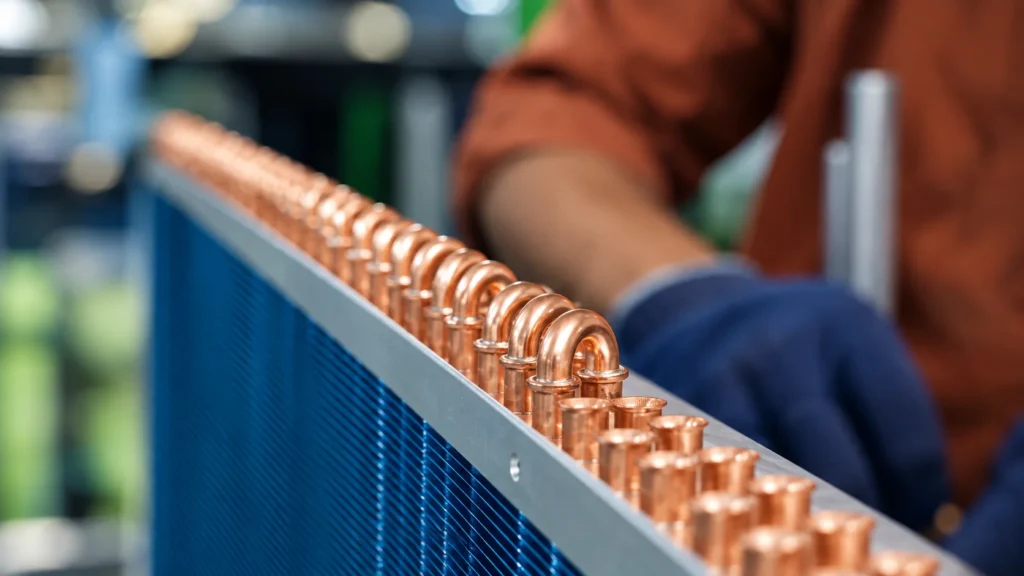
How can the production of HVAC coils expand to accommodate new refrigerants, increased efficiency goals, and rising demand without sacrificing quality? Prijai describes its methodology.
The HVAC Industry Is Changing Fast
Today’s HVAC systems are developed differently than those from ten years ago. Heat pumps are becoming more widely used. A2L refrigerants and other low-GWP alternatives are being pushed by refrigerant regulations. Equipment is being pushed to perform more tasks in less area, while efficiency goals continue to tighten.
The heat exchanger coil is the central component of each of these systems. Coil makers are faced with an operational and engineering dilemma as demand increases: how can you scale up while maintaining the same level of performance in every coil?
What “Scaling” Really Means for Coil Manufacturing
Scaling is not just making more coils. For HVAC OEMs, it means being able to deliver:
Volume: higher output as orders grow
Variety: many configurations, not a single product
Consistency: the same dimensions and performance from the first unit to the last
Adaptability: readiness for new refrigerants, materials and designs
Reliability: on-time delivery that keeps the OEM’s own line moving
A supplier who can deliver only one or two of these becomes a bottleneck as the OEM grows.
The Five Pillars of Prijai’s Approach
1. Capacity Built Ahead of Demand
Prijai operates five manufacturing plants across Maharashtra, with two more underway. With roughly 17,000 sq. m. of manufacturing space and annual capacity above 200,000 units, the network is designed to take on growth rather than react to it.
2. Engineering Depth for New Technologies
Over more than three decades Prijai has developed 500+ heat exchanger configurations. That experience helps the engineering team evaluate how coil design choices respond to new requirements, such as charge reduction, flammability constraints under A2L refrigerants, and durability under thermal cycling. These are the themes our technical research explores, including our whitepaper on micro-channel versus fin & tube designs.
3. End-to-End Manufacturing
Prijai produces fin & tube heat exchangers, copper system tubing and fittings, and complete OEM assemblies. With these under one roof, OEMs deal with fewer suppliers, fewer handoffs and a single partner accountable for the result.
4. Controlled, Repeatable Processes
At scale, small variations multiply. Controlled manufacturing steps, defined quality checks and testing before dispatch keep each coil within specification. The goal is simple: a coil built today and a coil built next year should behave the same.
5. Protection for Real-World Conditions
HVAC equipment runs in demanding environments, from coastal salt air to extreme temperature swings. Selecting the right materials and corrosion-protection treatment is part of building for long life. Our technical report on coil treatments in high-salinity environments covers this in detail.
Designing for Manufacturability
The best way to scale is to design for it from the start. Prijai’s engineers work with OEMs early to consider:
Dimensions and tolerances that suit production and the OEM’s assembly line
Circuiting and configuration choices that balance thermal performance and manufacturing efficiency
Material selection matched to the application and operating environment
Packaging and handling that protect coils through to the customer’s line
Decisions made at the design stage often determine how smoothly production ramps later.
Supporting OEMs Through Growth
Prijai already supports HVAC OEMs through production scale-ups, delivering heat exchangers at the volume, consistency and quality the business expansion requires. The same approach applies across air conditioning applications such as fan coil units, heat pumps and ducted split systems, as well as refrigeration and data-centre cooling.
What OEMs Should Ask a Coil Partner
If you are planning to scale, these questions help separate suppliers who can grow with you from those who cannot:
How much capacity can you commit to, and how quickly can it expand?
How do you keep quality consistent across batches and across plants?
Can you support multiple configurations, not just one standard coil?
How are you preparing for new refrigerants and designs?
Who is accountable for coils, tubing and assemblies together?
Looking Ahead
Future HVAC systems will be more demanding of each component, more compact, and more efficient. Capacity, engineering depth, and disciplined processes must all work together to scale coil manufacture to meet them. Prijai is still building on that foundation.
We would like to know about any plans you have for your next stage of development.